
Trending
This story is from July 31, 2016
In search of leprechauns, fairies and banshees...
The journey is the destination when you are on the Causeway Coastal Route in Northern Ireland, in search of magic and folklore
The little people are watching,” whispers my guide Billy Scott as I shiver in the cold, my jacket wrapped tightly around me. The winds howl through the trees. It is dark and dramatic. I am standing in front of a little nursery filled with sculptures that look straight out of a fairy tale.

Of wailing winds and banshees
Ruins of churches and castles stare at us from atop cliffs. The wailing of the winds sound like banshees from the trees. Small inns and taverns along the coastal villages are home to ghosts. The sea and the sky are in shades of grey. Forests are enchanted. I stop to soak in the view. A hazy canopy of branches, dipped in various shades of green greet me as the murmurings of a rivulet sound like music to the ear. Northern Ireland is hauntingly beautiful – its eeriness and melancholy only add to the charm.
The journey becomes the destination. Billy and I are driving from Belfast on the coastal route, stopping at castles and coastal hamlets. The 12th century Carrickfergus Castle is one of the oldest stone castles in the region built by the Normans and it stands overlooking the Belfast Lough or the Carrickfergus Bay.
A well in the castle is, however, haunted, apparently by a soldier who was wrongly executed for murder. The town is steeped in medieval lore and stories of ghosts.
We continue on our journey and pass through Glenarm, a pretty coastal village with its historic lanes and cobbled streets which is the first of the nine glens in County Antrim. Looking straight out of a picture postcard, the village also has a very old private castle, home to the Earls of Antrim.
The skies darken as we drive past the pretty harbour of Carnlough, where an unusual war hero is remembered with a plaque – Paddy the pigeon. A recipient of the Dickin Medal, Paddy was one of the pigeons trained during World War II to pass messages. The Irish carrier pigeon took about four hours and 50 minutes to cross the 230 miles of the English Channel as he flew passing on coded messages.
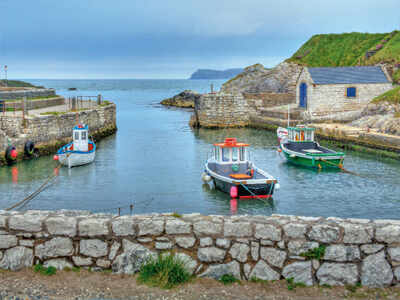
We finally reach Ballintoy, another harbour which became famous as a Game of Thrones destination. Rocks and rock formations lend a fantasy touch to this dramatic landscape. As we drive past the village, we visit the Carrick-a-Rede-Bridge that dangles precariously 98 feet above the rocks, connecting the mainland to a tiny island called Carrickarede. The bridge swayed by the winds is about 66 feet, and is believed to have been built by fishermen to check their fishing nets from top, to catch salmon.
legendary storytellers
Nothing prepares me for my first view of Ireland’s first Heritage Site, Giant Causeway, a natural site caused over 60 million years ago due to volcanic activity with 40,000 basalt columns formed out of it. I love the Irish for their stories. They can make even a basalt column and a volcanic site into a legendary story around giants.
Ireland’s favourite giant, Finn MacCool, was challenged by the Scottish giant Benandonner who goes into hiding when he realises that the Scottish giant is bigger than him. Finn’s wife, however, tucks him in a cradle when Benandonner knocked on his doors. Seeing the massive baby, the Scottish giant apparently fled for his life destroying the causeway originally built by Finn, so that he wouldn’t be followed.
But it doesn’t end there. The Irish with their humour and sense of imagination have named many a rock formation. Look out for the Organ, the Chimney Stacks, the Giant’s Boot before posing at the Wishing Seat, among others. And as the cold winds bite into my skin, I head to the mammoth visitors’ centre to lose myself in a world of fable and folklore.
Our last port of halt before the sun calls it a day takes us to rugged cliffs overlooking the sea. A gaunt spectacle greets us. Perched proudly are the ruins of an ancient castle. There is an air of melancholy in the magnificent ruins. Built in the 13th century, the ramparts and turrets hide many a secret like the ghost of a broken-hearted woman, who roams through these windowless ruins.
As darkness envelopes the sky and the lighthouses wink along the coastline, I end the 120-mile Causeway Coastal Route with a final visit to the oldest distillery at Bushmills to flavour the spirit of Ireland before calling it a night.
Giant Causeway is a natural site caused over 60 million years ago due to volcanic activity with 40,000 basalt columns formed out of it

About the Author
Lakshmi SharathEnd of Article
FOLLOW US ON SOCIAL MEDIA









Photostories
lifestyle videos
Featured In Lifestyle
Popular Categories
Entertainment NewsBollywood NewsTollywood NewsKollywood NewsMollywood NewsMovie ReviewsLatest Hindi MoviesLatest Tamil MoviesMX PlayerParenting TipsHome RemediesWeight LossBeauty TipsParenting TipsHindi VideosHindi Video SongsBhojpuri Music VideosLatest Telugu MoviesBhojpuri Music VideoHindi TV News
Trending in Entertainment
Latest MoviesBollywood MoviesHollywood MoviesTamil Movies 2024Telugu Movies 2024Malayalam Movies 2024Kannada Movies 2024Marathi Movies 2024Bengali Movies 2024Top Rated Movies 2024Best Hindi MoviesBest English MoviesBest Telugu MoviesBest Tamil MoviesBest Malayalam MoviesBest Kannada MoviesBest Bengali MoviesUpcoming Hindi MoviesBest Movies Of All TimeBest Hindi Movies of All Time
Trending in Etimes
Horoscope TodayNumerology Predictions TodayKamala HarrisRobert F Kennedy JrBarron TrumpElon MuskAnna Paulina LunaJustin TrudeauTrump Town Hall Key TakeawaysInternational Day of PeaceDonald TrumpSNL 50 SeasonKamala HarrisSituationship TipsMagnesium DeficiencyRelationship TipsSean Diddy CombsAlzheimers DiseaseJennifer Lopez
Trending in TV
Trending in Lifestyle
Trending in Regional
Movie Reviews
Yudhra ReviewJo Tera Hai Woh Mera Hai ReviewKahan Shuru Kahan Khatam ReviewHis Three Daughters ReviewNever Let Go ReviewDancing Village: The Curse Begins ReviewTransformers One ReviewFirst Love ReviewBerlin ReviewThe Buckingham Murders ReviewSpeak No Evil ReviewVisfot ReviewThalapathy Is The G.O.A.T ReviewRebel Ridge Review
Upcoming Hindi Movies
Latest News
'Virat shuru hoga Australia se': Basit Ali says Kohli's low scores vs Bangladesh not an issueAstrology-Inspired Characters in Movies: A Cosmic Connection on the Big ScreenTest | War 2: Hrithik Roshan, Kiara Advani's romantic chemistry grabs attention in viral picsAstrology-Infused Plotlines: The Cosmic Connection in Bollywood and HollywoodEC to have 'zero tolerance' towards use of money power in Jharkhand assembly pollsThrowback: When Parineeti Chopra shined in yellow during her joyful haldi ceremony celebrationsICAI CA Final Exam for Nov 2024 postponed due to Diwali, new exam date announced: Check official notice hereWhy you should avoid falling for your best friendEpic Last 'Monster' Standing match and more exciting matches announced for WWE RAW (9/30)Alia Bhatt reveals she and Ranbir Kapoor chose Raha's name at Jr NTR's house: 'He wished to pick the same name for his daughter'Donald Trump shares 'nail salon gossip' that Kamala Harris paying $700 for...Astrological Themes in Popular Film FranchisesBiden acknowledges he's running out of time as violence escalates in Middle-East: Aides‘My brother is critical but stable’; Veteran actor Manoj Mitra’s brother debunks death hoaxTirupati Laddu controversy: Prakash Raj vows to meet Pawan Kalyan for one-on-one discussionSocial media owners, generative AI biggest threats to online news: Experts warnSean 'Diddy' Combs predicted his arrest for 'freak offs' in 1999 video: They're gonna probably be arresting me doing all types of crazy thingsWhy there are growing cases of respiratory disease in India
Copyright © 2024 Bennett, Coleman & Co. Ltd. All rights reserved. For reprint rights: Times Syndication Service